Section 1 – The Origins and Development of Ryūshin Shōchi Ryū
Ryūshin Shōchi Ryū is a school of classical Japanese martial arts centered on iaijutsu and kenjutsu, founded by Master Terutaka Kawabata, a swordsman and Japanese sword appraiser. Its lineage derives from Tenshinshō Jigen Ryū, a tradition said to have been passed down continuously since the Muromachi period.
Tenshinshō Jigen Ryū is said to have originated in 1508 (Eishō 5) with Tose (Kose) Yozaemon no Jō Osamune, later known as Setoguchi Bizen no Kami Masamoto. For many years, the tradition was transmitted in secrecy. Its existence was not publicly confirmed until the Meiji period or later, and it is said to have been passed down privately for approximately 400 years.
Following the Meiji Restoration, Tenshinshō Jigen Ryū opened its doors more widely for the first time under its 27th headmaster, Genshin Ueno. In 1964 (Shōwa 39), the Shōbukan, a comprehensive martial arts dōjō, was established in Asakusa, Tokyo, where Headmaster Ueno personally instructed his students, including Master Kawabata. After Ueno’s death, Kawabata continued his training and established the Seiseikan in Akabane, Tokyo. In 2006 (Heisei 18), he founded Ryūshin Jigen Ryū. Subsequently, in 2011, the school was renamed Ryūshin Shōchi Ryū to express its guiding philosophy more clearly.
In 2008, Kunikazu Yahagi, one of Master Kawabata’s senior disciples, became the second headmaster.
Master Yahagi actively traveled overseas, personally providing instruction and cultivating students in various locations. Today, the school has affiliated dōjō throughout the United States, Europe, and Asia, where practitioners around the world devote themselves to daily training. In 2023, Yoshio Watanabe, also known as Ryūetsu, succeeded as the third headmaster following his appointment by the first headmaster, Master Kawabata. Headmaster Watanabe is primarily responsible for instruction within Japan, while Master Yahagi continues to oversee activities overseas. In this way, the school quietly continues its development, transmitting the spirit and physical culture of classical martial arts to the modern age.
Section 2 – The Character of Headmaster Watanabe
The third headmaster, Master Yoshio Watanabe, is not only a successor who carries the techniques and principles of Ryūshin Shōchi Ryū into the present day, but also a martial artist with extensive knowledge of both equestrianism and Japanese swords. Because his father was a senior disciple of Kanzan Satō, a renowned authority on Japanese sword appraisal, Watanabe became familiar with the structural and functional beauty of Japanese swords from childhood. As an adult, he deepened his exploration of the spirituality inherent in samurai culture. His perspective goes beyond that of a mere sword enthusiast or collector. It is grounded in the practical understanding of the sword as a living weapon, and is distinguished by his view of the sword not as a static work of art, but as something inseparable from the use of the body.
Furthermore, Headmaster Watanabe has practiced equestrianism for approximately half a century, beginning in his twenties, and has competed at Grand Prix level in Western-style riding. The riding skills he developed over many years gave him unique insights into the manipulation of the center of gravity and control of the body, which are said to have greatly influenced his subsequent swordsmanship training.
Surprisingly, it was not until his thirties that Headmaster Watanabe began seriously studying swordsmanship. The first headmaster, Master Kawabata, had also studied under Kanzan Satō and was a junior fellow disciple of Watanabe’s father. As a result, the two families maintained a close relationship. Watanabe himself is said to have regarded Kawabata as an older brother. Although Kawabata had long encouraged him to study swordsmanship, Watanabe was so absorbed in equestrianism at the time that he persistently refused the invitation. However, when a particular event eventually led him to begin studying swordsmanship, he became deeply fascinated by it and devoted himself to training so intensely that he would forget to eat and sleep.
Having experienced such diverse forms of physical training, Headmaster Watanabe has consistently maintained a rational approach to teaching.
“Even among traditions, there are things that do not make rational sense. We examine them one by one and pursue the question of what might replace them.”
The martial arts described by Headmaster Watanabe extend beyond technical theory alone. Underlying his approach are Japanese perspectives on the body, history, and even life itself. Throughout his words, a consistent attitude emerges: rather than regarding rationality and tradition as opposing concepts, he seeks to integrate them through the body.
At the same time, Headmaster Watanabe is a gentle man with a rich sense of humor. He occasionally lightens the atmosphere with jokes and never behaves in an intimidating manner, even during training. His gentle treatment of his students reveals both the ability to win people’s trust, cultivated through his experience as a successful businessman, and his naturally generous character.
Another principle Headmaster Watanabe keeps in mind when teaching younger students is the importance of opening the other person’s heart. If you wish someone to open their heart to you, you must first open your own. He explains that this resembles the concept of sasoi, or inviting an opponent’s action, in martial arts.
“If you show your opponent an attitude of ‘I’m going to attack!’, they will immediately become cautious. Conversely, what happens if you open your body first? Your opponent will instinctively step in. That is when you finish them.”
Section 3 – Activating the Deep Muscles of the Lower Back and Abdomen: Tenkū no Tachi
Headmaster Watanabe believes that, in modern martial arts, merely imitating the movements of kata does not lead to an understanding of their essence. Even with beginners, rather than teaching kata immediately, he prioritizes correcting their bodies so that they can move rationally.
“For students who have just joined, we thoroughly teach them how to walk and sit when performing the formal bow. Walking and sitting without disturbing the body’s axis are fundamental to everything. The way you use the soles of your feet is also extremely important.”
Furthermore, Headmaster Watanabe considers the lower abdomen the most important area in the use of the body. The deep muscles of the lower back and abdomen are referred to as inner muscles in sports terminology. The central point where their activity is concentrated is the region traditionally called the tanden or hara. This is particularly evident in Tenkū no Tachi, one of the fundamental training exercises of Ryūshin Shōchi Ryū.
According to the explanation given by second headmaster Yahagi, the practitioner begins with the left foot forward, the feet separated front to back, and assumes an iaigoshi posture. From an In position, with the hips drawn backward and the back slightly rounded, the practitioner places a hand on the sword’s hilt. The sword is then drawn through a Yō movement, pushing the hips forward and extending the upper body backward. Afterward, with the left foot still forward, the practitioner draws the hips backward again, returning to the In posture, while pulling the sword horizontally backward and placing the hilt at approximately one-third of the blade’s length. Finally, the sword is raised from its horizontal position and returned to the scabbard. There is also a variation in which the left foot is drawn backward during the sheathing movement.
When the movements generated by extending the lower back (Yō) and rounding it (In) are performed carefully with coordinated breathing, they can strengthen and activate the deep muscles of the lower back and abdomen. Eventually, once sufficient proficiency has been achieved, performing these movements rapidly and with minimal motion can lead to the generation of explosive power. The underlying principle also has similarities to hakkei, the issuing of explosive power in Chinese martial arts.
The kata of Ryūshin Shōchi Ryū sometimes possess a flowing elegance reminiscent of sword dancing. However, this beauty is by no means merely decorative. Rather, it emerges as the result of rational bodily movement generated from within, and it is precisely here that the basis of their practical effectiveness may be found. The contributions of second headmaster Yahagi, who has extracted these principles from the kata and continued teaching them to students overseas, are also considerable.
Headmaster Watanabe, however, adds another important element: the sensation of being able to use the hip joints freely. More precisely, this means being able to use the muscle groups surrounding the hip joints both flexibly and powerfully. Through this ability, the body’s axis can change freely, allowing the tip of the sword to trace an endless variety of trajectories.
“When a four-legged animal, such as a lion, walks, it makes full use of the muscles at the base of its thighs, around the hip joints. Even when standing upright, the structure of those muscles does not change, so it is important to remain conscious of using them properly. Our school’s Songyō kata, a form of paired swordsmanship in iaijutsu, is specifically intended to train the muscles around the hip joints.”
Indeed, Songyō, a distinctive form of paired swordsmanship in Ryūshin Shōchi Ryū, possesses an intensity rarely seen in other schools. The exchange of techniques, in which practitioners close the distance as though running toward one another while maintaining low postures, crossing their techniques in an instant, stands in striking contrast to the impression of quiet kata practice. Yet there can be little doubt that the foundation making such fierce movements possible lies in the function of the lower abdomen, centered on the hip joints. This can truly be described as a bodily understanding unique to Headmaster Watanabe, who has devoted half his life to equestrianism.
Of course, the hara (tanden) and the hip joints are not opposing elements. Only when the two are organically integrated does a sword as strong and flexible as a willow emerge from within the body.
Furthermore, Headmaster Watanabe believes that a body developed through these methods of physical movement also brings forth the instinctive senses that human beings inherently possess as animals.
Section 4 – The Sensation of Ki Experienced at the Boundary Between Life and Death
“At an advanced level of martial arts, you must be able to sense your opponent’s intention to cut. When they think of cutting, that intention enters their body. The moment you perceive it, you must execute your technique. This is the kind of training you must undertake. That is where true martial arts begin.”
Headmaster Watanabe further explains that the essence of martial arts lies in a contest of ki.
“When facing an opponent, if you can first cause their ki to dissipate, you can win. Even if they attack with all their strength, their ki has already been drained. I believe that swordsmanship in earlier times generally worked in this way.”
In his twenties, Headmaster Watanabe fell from a horse during equestrian training and narrowly escaped death. Although he survived miraculously, he subsequently suffered from severe aftereffects and, at one point, even contemplated taking his own life.
What saved him was his encounter with Eastern medicine. Having met an excellent teacher and searched desperately for a path to recovery, Watanabe gradually awakened to the sensation of ki.
“Thanks to having wandered between life and death, I was able to acquire the ability to manipulate ki. However, teaching this to my students is extremely difficult. I am currently considering how I can convey it to them.”
Section 5 – Bushidō as a Practical Philosophy
Headmaster Watanabe does not romanticize Bushidō as a matter of spiritual ideals. Rather, he regards Bushidō as fundamentally a form of professional ethics intended to maintain order, a practical philosophy born from the sense of responsibility held by those entrusted with the lives of others.
His thinking is distinguished by his understanding of Bushidō not as the idealized philosophy refined during the Edo period, but as a practical philosophy that emerged from the realities of the battlefield and governance.
“Originally, Bushidō was, in a sense, a profession established by people whose role was to protect the Emperor and maintain order. During the peaceful Edo period, they established standards for how a samurai ought to behave. That was admirable too, but essentially, that was a philosophy of a peaceful era. Bushidō was not originally a philosophy for creating peace. In a sense, it was exclusively defensive. You absolutely had to win. I believe that cultivating the military strength necessary to do so is what it meant to be a samurai.”
Headmaster Watanabe feels a strong sense of crisis over the gradual loss of this spirituality in modern Japan. He is said to be prepared to devote the remainder of his life to restoring it.
“Fundamentally, if we are to spread martial arts from now on, what matters is the spirituality of how we regard life and death. It is not simply about techniques or performing arts. Our school has many students overseas, but in that sense, how many of them will be able to inherit the genuine spirituality? I think it would be wonderful if the students who remain could contribute to world peace through martial arts.”
Overall, Headmaster Yoshio Watanabe’s philosophy of life and martial arts can be summarized in a single idea: rediscovering the essence of Japanese culture through the body. Martial arts are not merely techniques of combat. They are a path toward integrating the human body, spirit, history, ethics, and aesthetic sensibility, and an endeavor to recover the original senses that modern people have lost.
Section 6 – Special Interview
First Headmaster of Ryūshin Shōchi Ryū – Master Terutaka Kawabata
Finding True Strength Within Softness
Here, we present a special interview with Master Terutaka Kawabata, the first headmaster, who may be regarded as the origin of Ryūshin Shōchi Ryū.
Interview and text by Masaki Satō
The Lesser-Known Side of a Martial Artist
Master Terutaka Kawabata, the first headmaster of Ryūshin Shōchi Ryū, was born in 1940 (Shōwa 15) and will turn 86 this July. For many years, he worked as a journalist and held important positions in numerous associations and organizations, while also being a martial artist who has transmitted the spirit and techniques of classical martial arts into the present day.
From his youth, he devoted himself to judō and kendō. At the age of 19, he entered the school of Genshin Ueno, headmaster of Tenshinshō Jigen Ryū. He attended training so diligently that his teacher told him, “At least take the first three days of the New Year off.” He eventually received menkyo kaiden, a certificate of complete transmission. Following his teacher’s death, Kawabata took responsibility for the tradition and worked to promote and develop it until Ueno’s sons later succeeded to the headmastership. In the early 2000s, he established the independent Ryūshin Jigen Ryū school and became its first headmaster. Before long, however, he transferred the position of second headmaster to his senior disciple, Master Kunikazu Yahagi. Shortly afterward, the school was renamed Ryūshin Shōchi Ryū to express its distinctive philosophy. In recent years, Kawabata appointed Master Yoshio Watanabe as the third headmaster, establishing the organizational structure that continues today: Yahagi serves as chairman and president of the Ryūshin Shōchi Ryū Association, primarily overseeing instruction overseas, while Watanabe serves as a standing director and is principally responsible for instruction within Japan.
Kawabata was also a member of the school of Kanzan Satō, a leading figure in the Japanese sword world after World War II, and witnessed firsthand the postwar revival of Japanese sword culture. His martial arts abilities, well known among those familiar with them, led to a friendship with the writer Yukio Mishima. Anecdotes from their relationship include Kawabata teaching Mishima the procedures of seppuku, as well as their discussions of Japanese swords and swordsmanship. Toward the end of the Shōwa era, Kawabata also successfully split a helmet from a suit of Momoyama-period armor using a sword made by Yoshindo Yoshihara, then attracting attention as a young swordsmith. Although Kawabata himself always emphasizes humility and never boasts of his abilities, his technical skill and knowledge can be considered beyond question.
Kawabata’s life clearly demonstrates that he has regarded martial arts not merely as techniques, but as an expression of Japanese culture itself.
What Master Kawabata values above all is the concept of a flexible and supple heart or mind, known as Ryūshin, the “willow heart.” This does not simply mean gentleness. Like a willow that yields to the wind, it describes a mind capable of adapting flexibly to changing circumstances without ever breaking. Rather than opposing force with force, true strength is found within softness. This is the foundation of Kawabata’s philosophy of martial arts.
Both body and mind should be supple. Kawabata believes that this is the state toward which people should strive through martial arts.
This philosophy is also clearly expressed in a saying by Yoshida Shōin that Kawabata frequently quotes: “One should understand what distinguishes human beings from birds and beasts.” Human beings are not creatures who should live solely according to instinct, but beings who should live within society with courtesy, compassion, and a sense of responsibility. For this reason, martial arts should not be techniques for defeating others, but a path through which individuals refine themselves and cultivate their humanity. Kawabata teaches that strength does not mean dominating other people, but possessing the ability to control one’s emotions and harmonize gently with those around them.
Master Kawabata has high expectations for those who will succeed him. He places great trust in the sincere attitude of the second headmaster, Master Yahagi, and holds his honest and straightforward character in high regard. At the same time, he has great expectations for the third headmaster, Master Watanabe, not merely as a successor to the school’s martial techniques, but as someone who will transmit Japanese culture and the spirit of Bushidō to the next generation. His wish is that the two men will work together to protect and nurture Ryūshin Shōchi Ryū.
For Master Kawabata, martial arts are not something confined to the dōjō. Modern society continues to change at a tremendous pace. Kawabata teaches that the true role of martial arts is to cultivate the ability to respond flexibly to those changes and survive. It is sincerely hoped that Ryūshin Shōchi Ryū will continue to develop steadily, and that the students who have received his instruction will embody Ryūshin in their own lives as they make their way gracefully through the turmoil of the modern world.
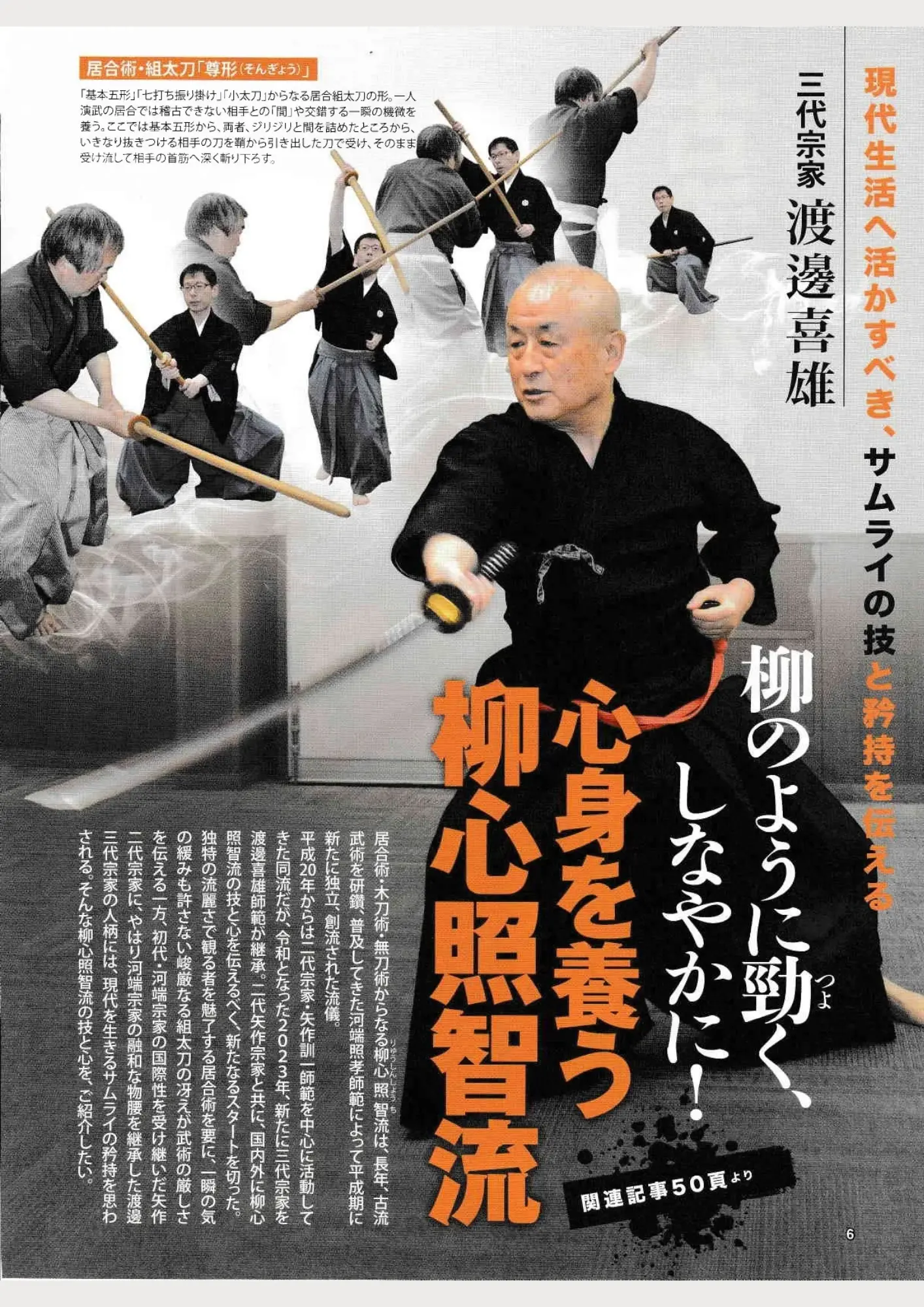
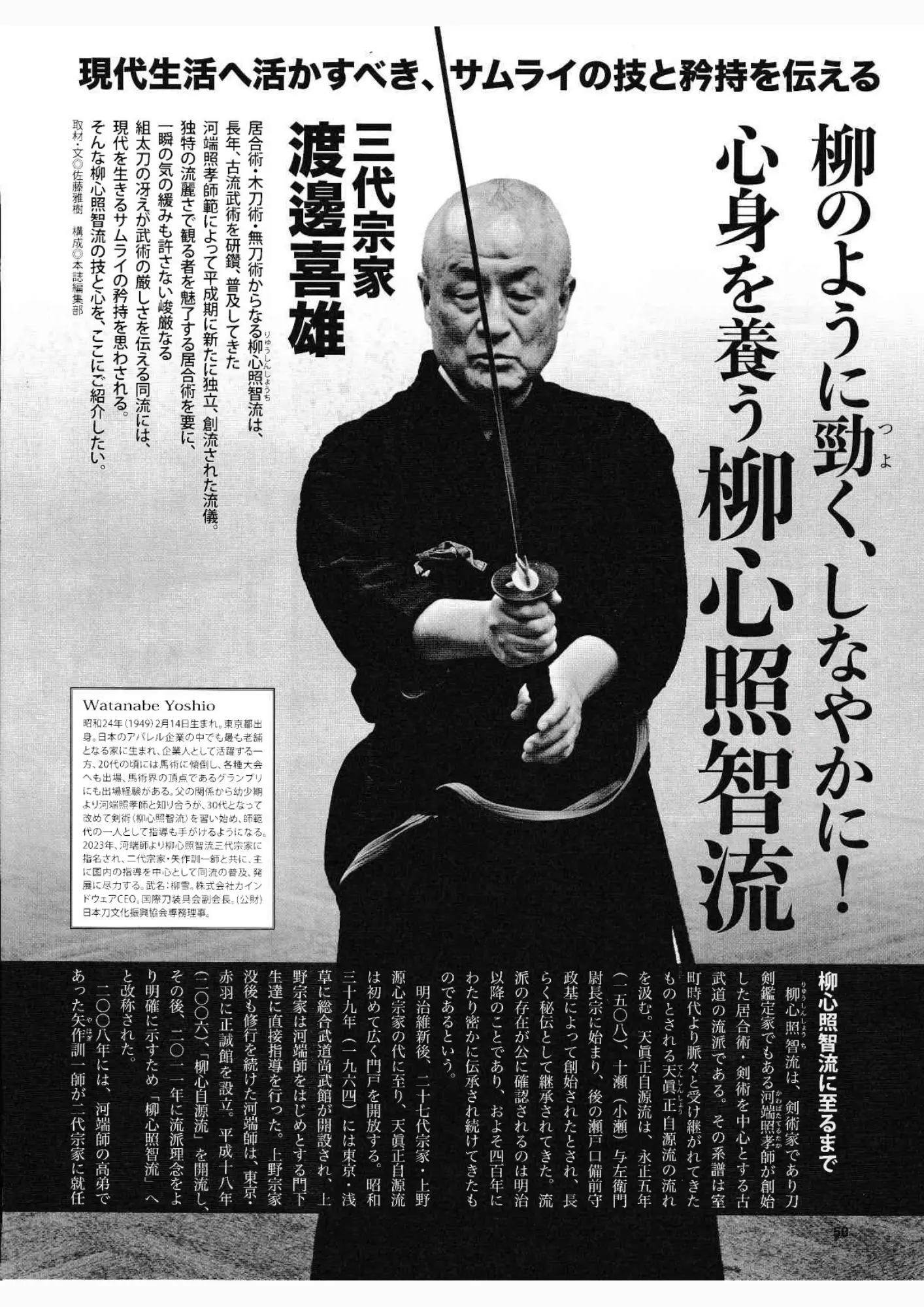
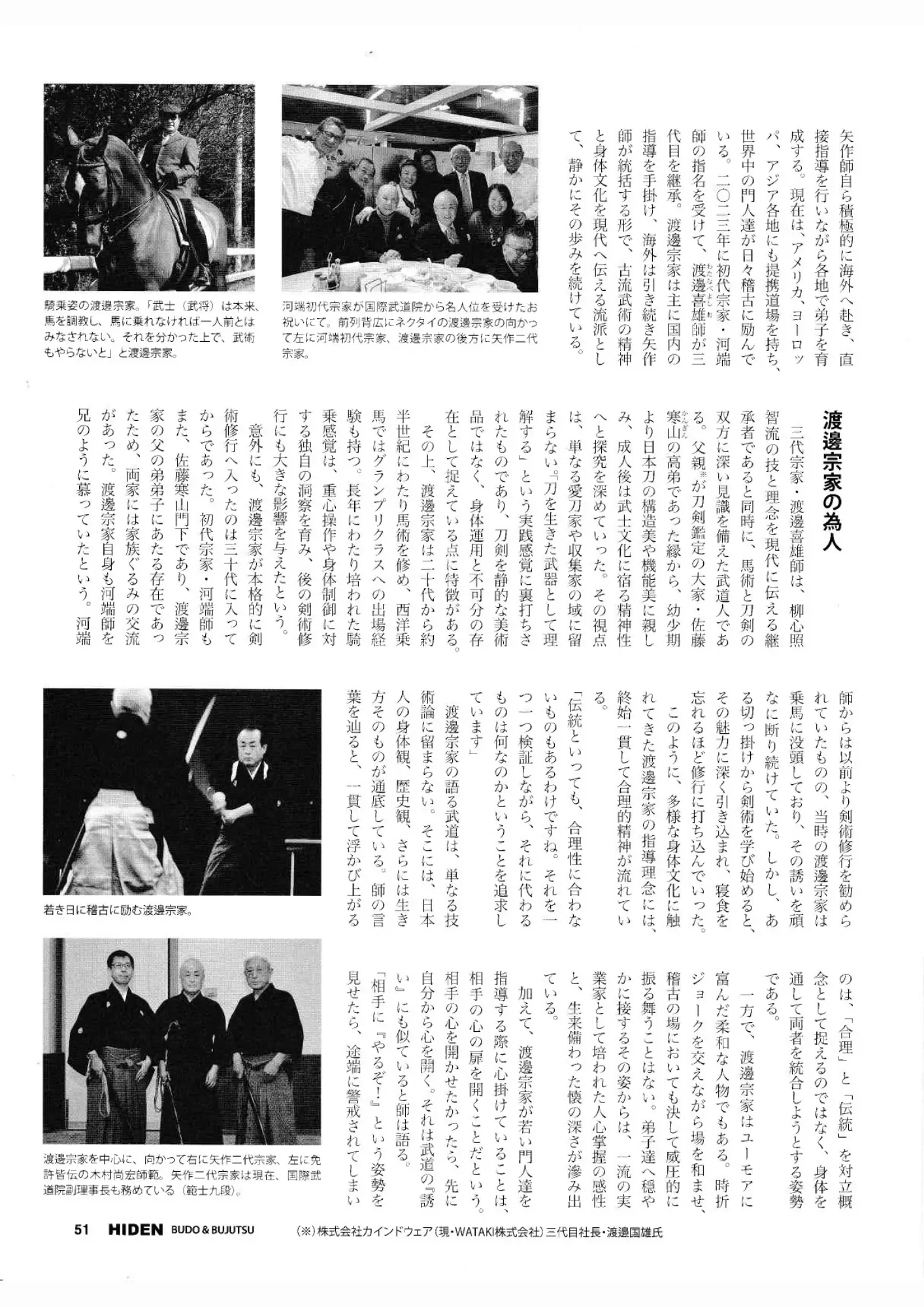
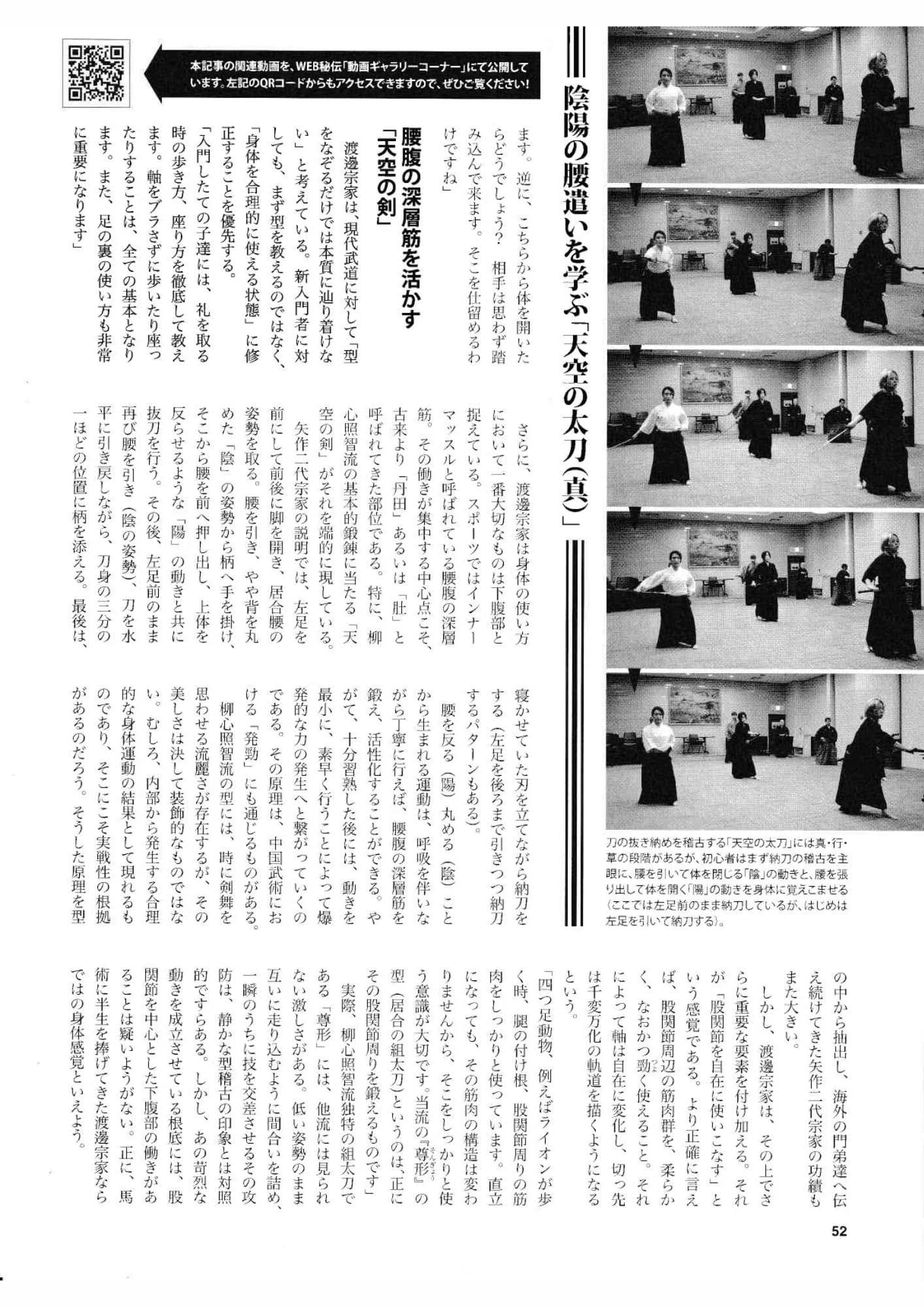
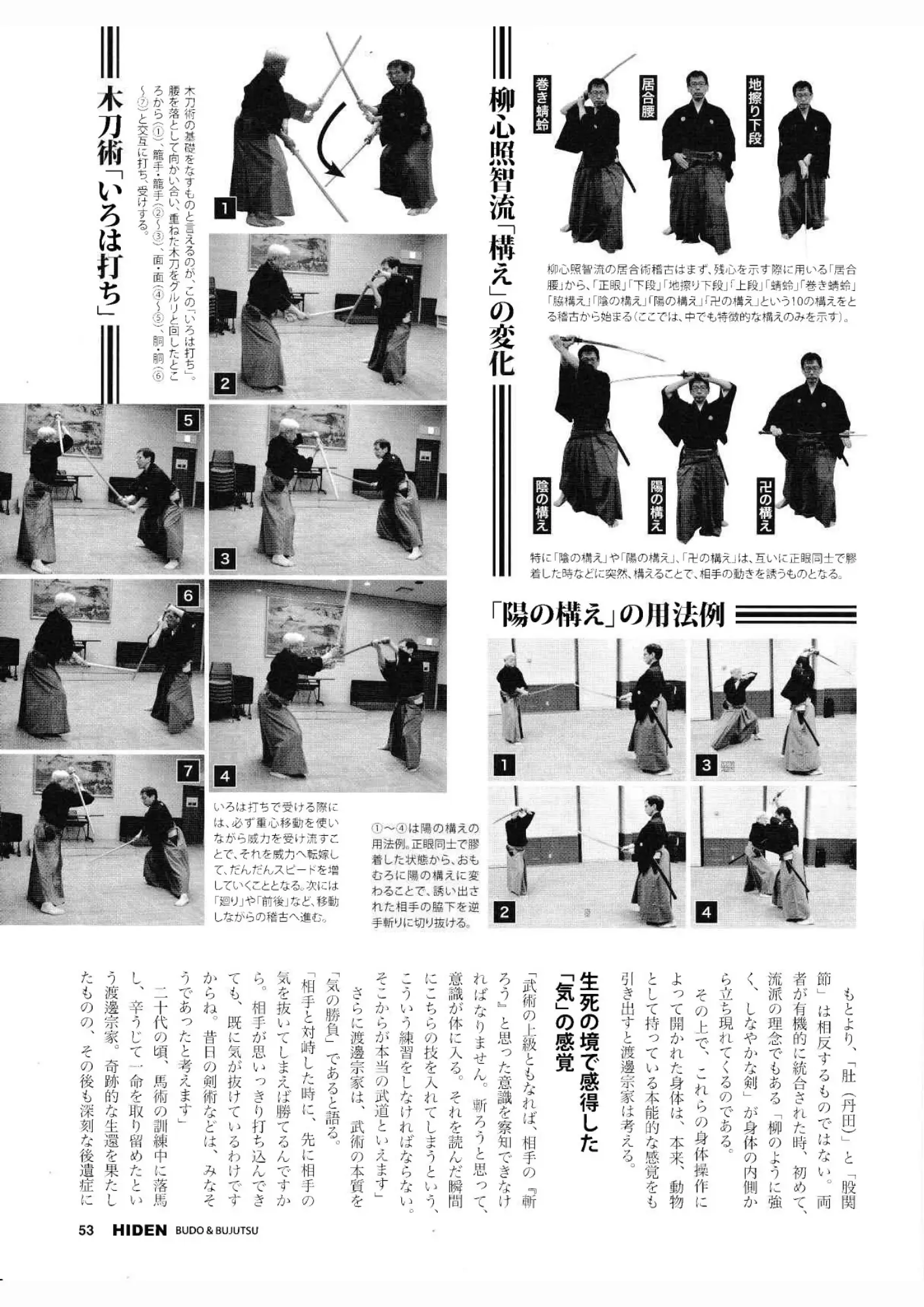
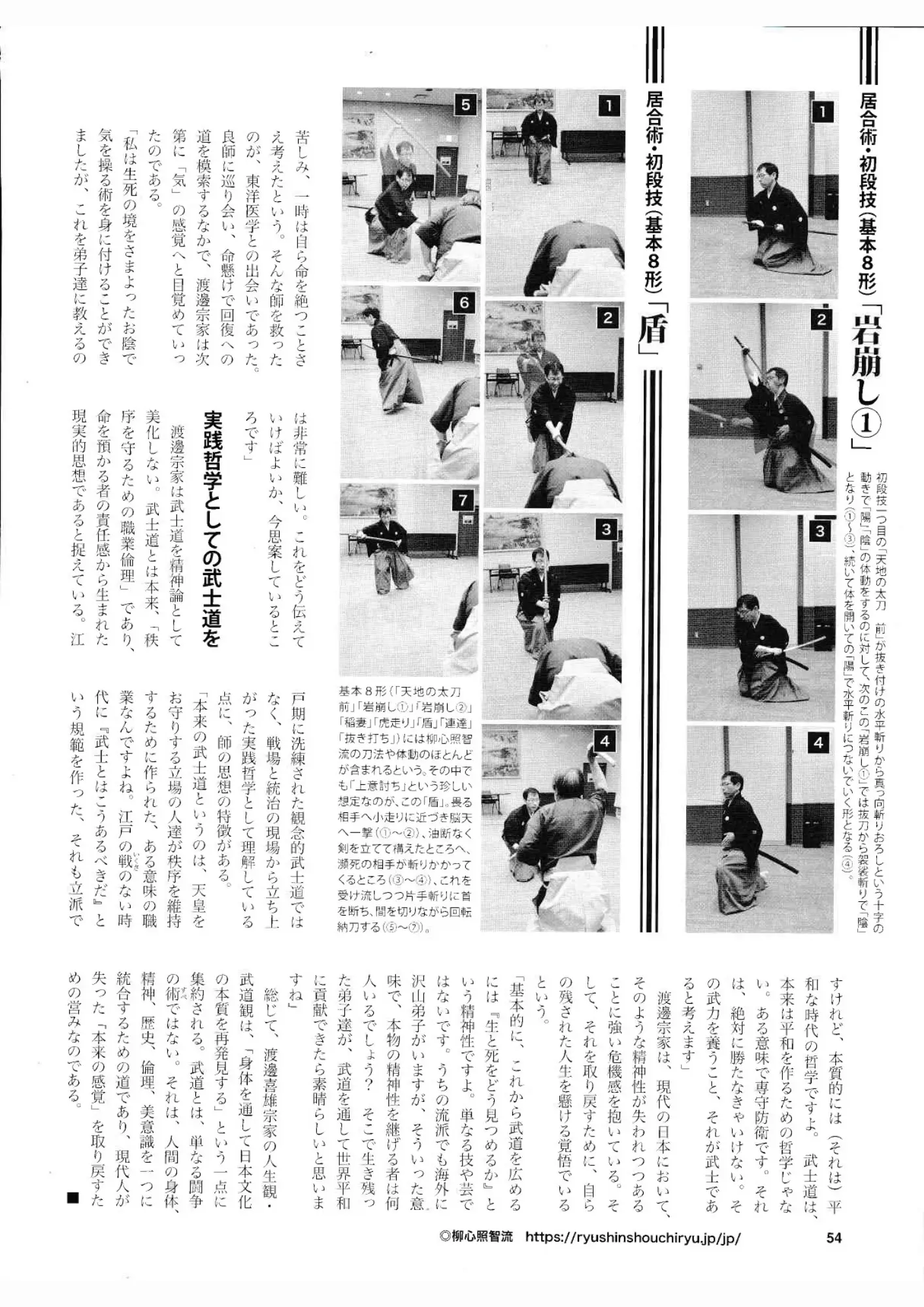
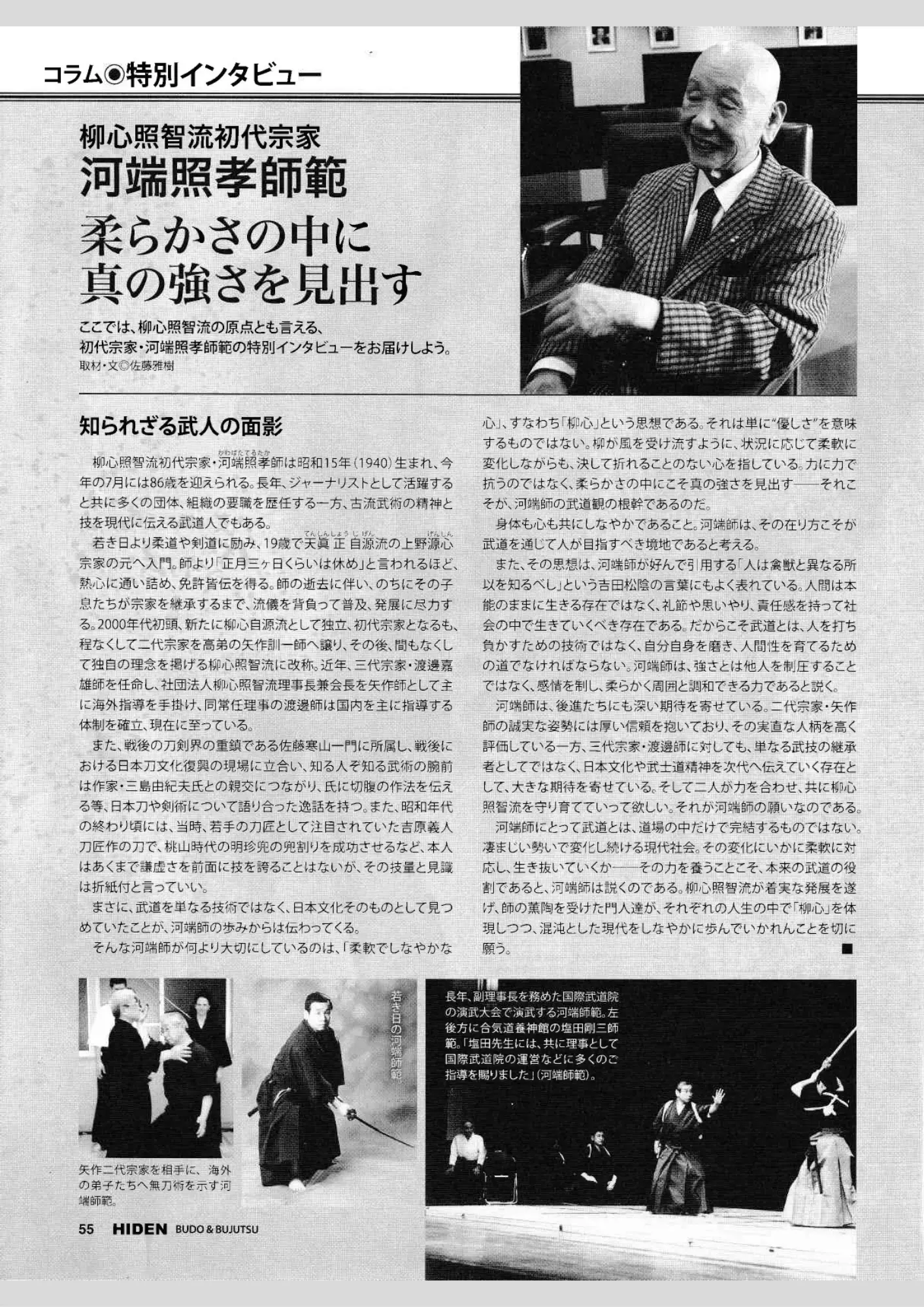
Photo Captions
Iaijutsu – Kumitachi: Songyō
This paired iaijutsu practice includes the Kihon Gohon, Nanauchi Furikake and Kodachi.
It cultivates an understanding of maai (combative distance) and the subtle timing of the instant when swords cross – qualities that cannot be developed through solo iaijutsu practice alone. The photographs show a sequence from the Basic Five Forms. Both practitioners gradually close the distance. When one suddenly draws his sword, the other draws his own sword from the scabbard to receive and deflect the attack, then executes a deep downward cut toward the opponent’s neck.
Headmaster Watanabe on Horseback
Headmaster Watanabe demonstrating his riding skills. “Originally, a bushi (warrior) could not be considered a warrior without understanding horses and being able to ride. Only after understanding this should one practice martial arts,” says Headmaster Watanabe.
Celebration Honoring First Headmaster Kawabata
A celebration held when First Headmaster Kawabata received the title of Meijin from the International Martial Arts Federation. In the front row, First Headmaster Kawabata is seated to the viewer’s left of Third Headmaster Watanabe, who is wearing a suit. Second Headmaster Yahagi stands behind Watanabe.
Headmaster Watanabe During Training
Headmaster Watanabe practicing diligently in his younger years.
Three Generations of Martial Arts Instruction
Third Headmaster Watanabe stands in the center, with Second Headmaster Yahagi on the right and Naohiro Kimura, who has received menkyo kaiden (complete transmission), on the left. Second Headmaster Yahagi also serves as vice chairman of the International Martial Arts Federation and holds the rank of Hanshi, Ninth Dan.
Activating the Deep Muscles of the Lower Back and Abdomen: Tenkū no Tachi (Shin)
Tenkū no Tachi, an exercise for practicing the drawing and sheathing of the sword, has three levels: Shin, Gyō, and Sō.
Beginners should first concentrate on the basic drawing-and-sheathing exercise, learning to draw the hips backward and close the body through In, and to extend the hips and open the body through Yō. The photographs show the practitioner sheathing the sword with the left foot forward. Initially, however, beginners should draw the left foot backward before sheathing.
Variations of Kamae in Ryūshin Shōchi Ryū
Iaijutsu training in Ryūshin Shōchi Ryū begins with iaigoshi, the posture used when demonstrating zanshin (continued awareness after a technique).
Students then proceed to the ten fundamental stances: Seigan, Gedan, Jizuri Gedan, Jōdan, Tonbo, Maki Tonbo, Waki-gamae, In no Kamae, Yō no Kamae, and Manji no Kamae.
Only the more distinctive stances are illustrated here.
Individual Photograph Labels
- Maki Tonbo
- Iaigoshi
- Jizuri Gedan
- In no Kamae
- Yō no Kamae
- Manji no Kamae
In particular, In no Kamae, Yō no Kamae, and Manji no Kamae are used to invite the opponent’s movement by suddenly assuming one of these postures when both practitioners are facing each other in conventional stances and have reached a stalemate.
Application of Yō no Kamae
Photographs ①-④ show an application of Yō no Kamae. From a stalemate in which both practitioners face each other in conventional stances, one slowly assumes Yō no Kamae to invite an attack. As the opponent closes in, the practitioner moves beneath the attacking arm and executes a reverse-grip cut.
Bokutōjutsu – Iroha-uchi
Iroha-uchi can be considered a foundational exercise in wooden sword techniques.
The practitioners face one another in lowered stances and rotate their crossed wooden swords in a circular motion (①). They then alternately strike and receive attacks directed toward the wrists or forearms (kote, ②–③), the head (men, ④–⑤), and the torso (dō, ⑥–⑦).
When receiving an Iroha-uchi strike, the practitioner should first make a substantial shift in body weight, using that movement to deflect the opponent’s attack and transform the force into power. As proficiency increases, the speed of the exercise is gradually raised. Training then progresses to mawari and zengo, incorporating changes in direction and forward-and-backward movement.
Iaijutsu – Shodan Techniques (Eight Basic Forms): Iwakuzushi 1
In the basic shodan techniques, the horizontal cut of Tenchi no Tachi Mae immediately after drawing the sword represents a Yō movement, opening the body. The following downward cut represents In, closing the body (①–③).
The subsequent Iwakuzushi 1 movement involves drawing the sword and executing a diagonal cut through In, followed by opening the body through Yō and connecting the movement to a horizontal cut (④).
Iaijutsu – Shodan Techniques (Eight Basic Forms): Tate
The eight basic forms – Tenchi no Tachi Mae, Iwakuzushi 1, Iwakuzushi 2, Inazuma, Torabashiri, Tate, Rentatsu, and Nukiuchi are said to contain nearly all the sword techniques and body movements of Ryūshin Shōchi Ryū.
Among these, Tate is particularly unusual because it depicts jōi-uchi, an execution carried out under orders from one’s lord or superior.
The practitioner approaches a formidable opponent with quick steps and delivers a strike to the top of the head (①–②). The practitioner then holds the sword upright without lowering their guard.
When the mortally wounded opponent attempts another attack (③–④), the practitioner receives and deflects it, executes a one-handed cut to the neck, and turns while creating distance before sheathing the sword (⑤–⑦).
Master Kawabata Demonstrating Mutōjutsu
First Headmaster Kawabata demonstrates mutōjutsu (unarmed techniques against an armed opponent) to his overseas students, with Second Headmaster Yahagi serving as his partner.
Master Kawabata in His Younger Years First Headmaster Kawabata during his younger years.
Demonstration at the International Martial Arts Federation
Master Kawabata performs a demonstration at a martial arts event organized by the International Martial Arts Federation, where he served for many years as vice chairman.
In the left background is Gōzō Shioda of Yoshinkan Aikidō. “Mr. Shioda gave me considerable guidance regarding the management of the International Martial Arts Federation while we served together as directors,” recalls Master Kawabata.